


I spent years caring what imaginary people thought. I would do my hair because I knew “someone” would see my flat, lifeless hair and think, That’s not how an important woman looks. I would think, Oh, did my lip color wear off? I don’t want to look half-dead, and hurry up and put some on. I wanted to live up to a certain standard I took on during my adolescence from magazines, TV, movies, and the like. I was self-conscious. ALL. THE. TIME.
Then, I got sick of it. I stopped wearing makeup, wore my hair in a braid, bun, or ponytail, and I dressed down. I had my 2nd, 3rd, and 4th child and was too busy anyway.
To be honest, as someone who deeply values freedom, I was just so over answering to imaginary people whose opinions I truly didn’t care about.
But, pause, am I saying we should all ditch our makeup, stop doing our hair and nails? Might as well live in cute little burrows like hobbits while we’re at it!
No, I had to find the balance. The bad guy in this story isn’t the makeup, dressing up, or even caring what people think. Genuinely, it’s not right that people have expectations and judgments of others, which is especially noticeable for women. Who’s to say how I should look? My kids don’t care. My husband loves me regardless of what I wear and whether or not I do my hair and nails.
Would you rather buy a house with pretty paint and a bad foundation or a house with a good foundation and ugly paint?
The villainin our story is building our confidence on a bad foundation.
Behavior. Feedback. More or less confidence.
Confidence is, after all, a feedback loop. You stand out. You do something someone doesn’t like. You get called out. You feel bad. You don’t dare repeat the behavior. There is no confidence in doing the thing anymore. Negative social feedback loop complete.
On the other hand, you do something others approve of. They give you affirmation. That feels good. You keep doing similar things to get similar results. You associate the thing with a positive result and are confident in repeating the behavior. Positive social feedback loop complete.
Kudos! You gained confidence.
What’s the problem then?
The problem is this: if your confidence is built around others’ expectations—as good as they might be—and not around intrinsic values and goals, your confidence won’t prove to be very durable.
As kids, we often build our confidence on being agreeable, compliant, good-looking, athletic, dependable, helpful, quiet. You get the point. Not that any of those things are inherently bad. I call it the carrots and sticks of growing up: incentives and punishments.
The catch is we never stop to dig deep and build confidence based on the person we might actually want to be.
So you go through life.
Your superficial confidence gets challenged by adversity, hard things, mean people, and people who just don’t see you the way the people you built your confidence around did.
And you think, The world’s not nice. I’m not a good fit here or there. And your confidence plummets. Soon, your confidence is spotty at best, and you think you just don’t have that it factor everyone’s writing books about.
Low confidence. This is guaranteed to happen when we build our confidence on external expectations, which is, of course, a moving target.
If you never built your confidence around things that are intrinsic to YOU—things you can control, things you care about based on your thinking, goals, ideas, and values—then likely you struggle with confidence.
I had to completly rebuild my confidence anchors, so read on to hear the 3 things that I found to work. This way you can build your confidence on things you can actually control. Your mind. Things you choose.
And no, that’s not easy work. But, it’s the way forward.
But first, the middle of this story: This is where I realized how important intrinsic motivation is
Early in my career, I was a schoolteacher.
This was where I realized why it’s so important to help people, no matter the age, find their own voice, hopes, dreams.
I taught second grade for four years, then fifth grade for a couple of years. For some weird reason, I thought my job was to show young people how to have their best life.
Somewhere along the way, though, I started thinking: Wait a minute, the whole system is built on supplying a workforce? No wonder it feels like an uphill battle every day. We’re just training people to comply and not to thrive, understand, or explore what is actually THEIRS.
I left the classroom and decided to try my help people have their best life thing on adults. I studied to become an image consultant near Washington, D.C., with a world-renowned image consultant known as The Image Architect.
Her name was Sandy Dumont, and she worked with many executives, media personalities, and political figures.
That’s where I learned impression strategies that get others to respect us and listen to our ideas.
I started to see how differently the confidence feedback loop works when someone is seen as important, given respect, listened to, and afforded instant credibility. They call that the halo effect. Essentially, because you came off so perfectly on first impression, the other person’s own confirmation bias sees everything else you do as perfect. It’s a definite cognitive bias, but here we are. Humans for ya.
Being treated as a VIP is not how the world works for the rest of us
You spent years trying to fit external expectations. And when you attained some level of recognition, when others validated you, you built your confidence on that.
But here’s the problem: when others hold the key to your confidence, it’s very easy to lose it.
You go through life needing affirmation, but it’s not always there.
You’ve become so accustomed to needing it that it feels normal.
And today, I want to challenge that norm.
I don’t know exactly what an ideal world would look like for raising kids with the right kind of confidence. But because I also grew up this way, I want to assure you that confidence built on external validation is a mirage.
The good news is you can start changing what your confidence is built on no matter your age.
So, if this is you, stop doing what you’ve always done to feel confident, and start doing these three things instead.
1. Start excavating and validating your own values, knowledge, stories, goals, interests…
Tune in to things that are intrinsic to you. Things that you value.
Simply start to be more aware of your best goals. Take inventory of them. Write them down. Value them. Hold them as important and keep them in mind. Don’t go and ask someone else. Don’t ask AI to tell you all the things it notices from the conversations you’ve had. Sit down and get in touch with the things you’d like to anchor to that are in the deepest parts of your identity. Your mission in life is to be the person you want to be. Isn’t that the very definition of freedom?
2. Dress and carry yourself like you’re on a mission using strategies, not emotion, and certainly not because you need them to like you.
Because, as I’ve stated many times, how you dress makes a huge difference in how you see yourself and how others see and treat you. You can literally short-circuit the negative feedback loop. People are wired to respond to clues and signals we give them. How we look triggers deeply-rooted signals that tell someone whether we’re important to listen to, worthwhile to work with, have revolutionary ideas, can handle responsibility, and the list goes on and on. Not because people are inherently horrible, just how we’re wired; and newsflash: not everyone is working on their biases.
Bottom line: people treat you differently when you carry yourself differently.
A girl can do and say anything she wants when she looks like a lady. -Isaac Mizrahi
So dress for respect, and carry yourself with great self-respect. You have worthwhile values, ideas, thoughts, and goals. You don’t need to be loud about them. Quietly protect them.
3. Replace the need for external validation with your own mission, based on your own thoughts and values.
Have unique thoughts. Some you’ve examined that you can actually communicate in a compelling and impactful way. Others you’re still wrestling with. You have values and principles you stand for. Your goals, hopes, and dreams. Your idea of a good life for you and those you love. Your mission is to live YOU.
The more you can replace the need for external affirmation with the desire to see who you can become without it, the more these things become a real part of you and the more you will enjoy the journey.
Because confidence is not a destination. It’s a way of being.
So there you have it: one, two, three. Is it easy? No. Is it simple? Yes.
Your confidence might be built on external factors you have no control of and it doesn’t feel good. You’ve been going through life beating yourself up over things you can’t control.
Start building your confidence on who you are.
If it were possible from early childhood, that children had adults around who helped them base their confidence on their intrinsic values, goals, ideas, thoughts, efforts, and so on. Imagine what a difference it could make.
Not because you were cute or compliant, followed instructions perfectly, or had a certain eye color.
But what if the education system, and society as a whole, were built around helping you explore your unique genius and your unique interests?
I don’t even know exactly what that would look like.
But for the sake of the math here, let’s say:
Confidence built on others’ expectations is
E (Extrinsic) + F (Feedback) = C (Confidence)
I (Intrinsic) + F (Feedback) = C (Confidence)
What changes internally? Before, your entire rubric for feedback was built on how close you came to external expectations. When you base your feedback on how close you’re getting to attaining your mission, you adjust, grow, and keep going forward according to feedback. It’s data.
Those are two very different equations. Two very different outcomes. Two very different experiences.
You can learn to navigate your own confidence.
It’s going to take effort. And it’s going to take some discomfort.
Because you’re no longer going to derive your confidence from other people’s approval, compliments, and validation.
Instead, you’re going to grow the internal fortitude that allows you to stand up and have confidence, regardless of what the outside world expects from you.
Present her to the world
From now on, when you dress, you do it pragmatically. Do it with a mission. You dress for success because you have a message, a mission, value to give. You understand that others are more likely to hear you when you send the right signals. It’s no longer because you’re expected to look a certain way.
You’re an ambassador for that person you found on the inside who wants to live out her chosen life.
With love,
Tatyana
As cloudy seasons blow your way, may you cheerful, sunny stay…
We all have those taupe, black, navy basics.
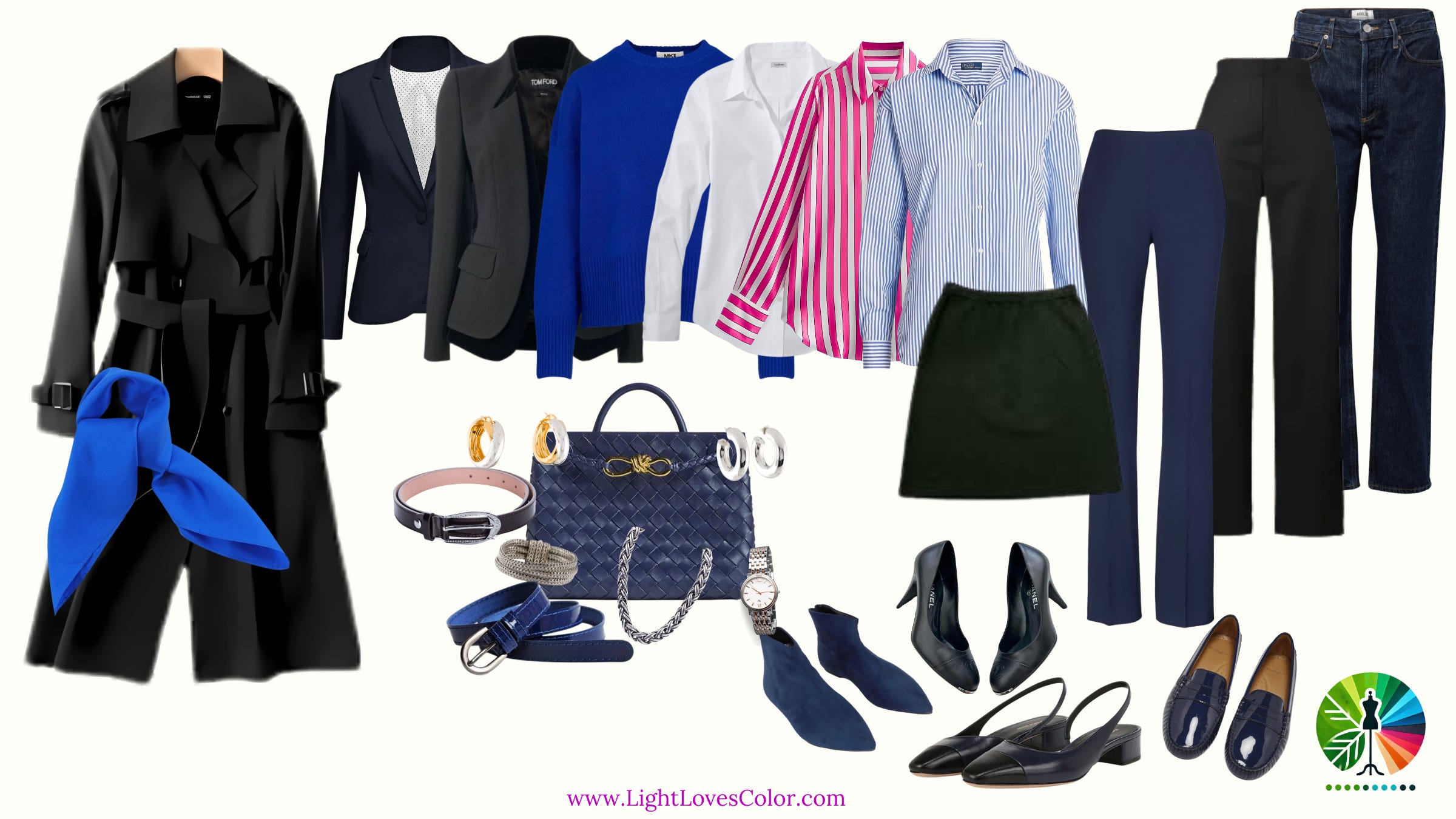
Remember the rules of color and facial luminocity: you can wear almost any color, but when it comes to color next to your face, choose ones that cast the most light. It’s like when a photographer puts a white paper under your face to reflect as much light as possible to remove any of those dark spots. You can do the same thing when you incorporate your best colors. If you’re like most people and have cool undertones, you would do great with a crisp white, jewel tones, pinks… and PURPLE is so awesome. Coincidentally, it’s having a moment right now. Grab a scarf (I love the magenta, emerald, turquoise, royal blue, hot, pink, peacock, purple tapestry, and voilet for the cool ladies) or two and multiply those rays of light to your advantage.


*affiliate links that allow a small commission if you purchase from them.
Have an amazing week!!!
Tatyana