


For most of history, color was restricted. Now we have access to the full spectrum of dyes, and yet many now reject bright colors.
Imagine being legally forbidden from wearing certain colors. Not discouraged. Forbidden.
Imagine a world where a deep crimson, brilliant blue, or vivid purple could signal wealth, rank, permission, political standing, or social danger.
That world existed.
For a very long time.
And strangely enough… parts of its psychology may still be hanging around in our closets.
Let’s talk about color.
Real color. The expensive kind. The powerful kind. The kind ordinary people often could not access.

Purple Wasn’t Just Pretty. It Was Power.
One of history’s most famous colors came from… sea snails.
Yes. Actual snails.
Tyrian purple — the legendary deep reddish-purple of antiquity — required extracting tiny glands from thousands of murex shellfish.
Thousands.
The process was slow, labor-intensive, famously foul-smelling, and shockingly expensive. (I’m not even talking today’s gas prices! Sorry, had to go there!)
In parts of the ancient world, purple could cost more than its weight in gold.
Think about that for a second.
Not “luxury-adjacent.” Not “premium.” More expensive than gold.
Who wore it?
Emperors. Rulers. Elite classes. People of great privilege.
In some societies, laws explicitly restricted who could wear purple.
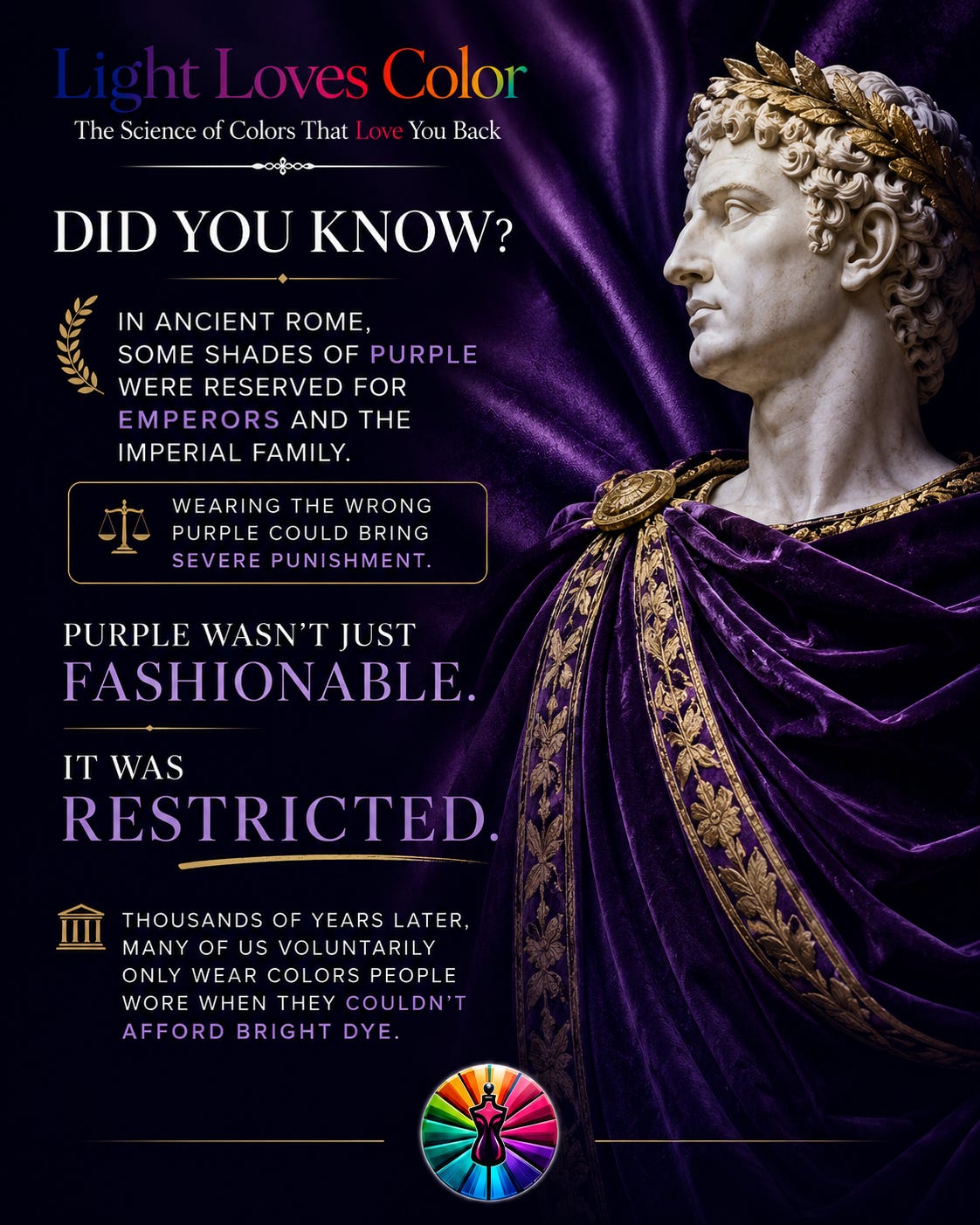
Color was not casual self-expression like it is today. Color functioned as a hierarchy. Visibility had rules. In other words, societies were deeply stratified. Well, and if you weren’t in the upper strata, you couldn’t ever afford color; wearing undyed wool or cotton (think russet, beige) or clothes with only muted dyes that anyone could easily access became associated with lower classes, while wearing dyed fabrics was elite.
The Blue That Bankrupted Painters
Or consider ultramarine blue.
The breathtaking deep blue associated with Renaissance paintings.
Made from lapis lazuli stone hauled from Afghanistan.
Painters prized it so highly they often reserved it for the most sacred or important elements in a work.
The Virgin Mary’s robes. Heavenly symbolism. Powerful visual focus.
Never background filler. It was so expensive, the people commissioning paintings would often have to itemize how much ultramarine blue was to be used and precisely where. They would have to pay for the pigments themselves, as painters would usually not be able to afford it.
Strategic placement.
We’ll come back to that.
Ordinary People Didn’t Necessarily Wear No Color.
But they often only had access to dyes from nature that were not very colorfast, therefore quite muted.
This matters historically.
The story is more nuanced than “rich people wore color, poor people wore beige.”
Many ordinary people absolutely used dyes.
Plant reds. Earthy yellows. Woad blues.
Local traditions. Regional embroidery. Folk garments rich with symbolism.
Human beings have loved color for a very long time.
But access mattered. Cost mattered. Durability mattered. Saturation mattered. Permission mattered.
The richest, brightest, rarest, most stable, most prestigious colors frequently fit closer to wealth, power, ceremonial life, and status signaling.
Not universally.
But often enough to notice a pattern.
Color had social weight.
Then Something Wild Happened.
In 1856, an eighteen-year-old chemistry student named William Henry Perkin accidentally changed the history of color.
He was attempting something completely different.
He failed.
And during the failure, he stumbled into vivid synthetic purple dye.
Mauveine.
Suddenly, colors that had once required snails, rare stones, imperial wealth, colonial trade networks, or enormous labor could begin becoming industrially reproducible.
Cheaper. More available. More democratic.
The locked gate opened.
For the first time in history, ordinary people gained access to colors previous generations could scarcely imagine wearing casually.
We inherited something remarkable.
A democratization of color.
So, why do so many modern wardrobes look like we’re afraid someone might accuse us of enjoying it?
The Modern Visibility Problem
Walk into many professional environments today.
What do you see?
Black.
Grey.
Navy.
Camel.
Dusty rose.
Muted olive.
Soft sage.
Understated minimalism.
Quiet professionalism.
Carefully calibrated invisibility.
Now let me ask a potentially uncomfortable question.
Did we choose that palette because it genuinely serves our faces?
Or because it quietly serves our need for safety?
There is a difference.
One is observation.
The other is social psychology.
And humans are deeply social creatures.
We adapt.
We blend.
We belong.
We minimize risk.
Sometimes beautifully.
Sometimes automatically.
Sometimes without noticing.
Visibility Can Feel Surprisingly Vulnerable
Let’s make this personal.
Have you ever bought a brighter garment, loved it in the store, wore it once…aaaaand quietly returned to your safer neutrals?
Why? Let’s pause there.
What happened internally?
Too noticeable?
Too energetic?
Too “not me”?
Too much for work?
Too cheerful?
Too visible?
Interesting.
Because Drab Rehab is not fundamentally about forcing color.
It is about examining our relationship to visibility.
The modern muted wardrobe may not always be a pure style choice.
Sometimes it is a negotiation with belonging, professional norm, personality identity, comfort, camouflage, risk management, and social expectations.
And perhaps…a long cultural inheritance about who is allowed to occupy visual space.
The Question Light Loves Color Wants To Ask
Not: “Does everyone need neon?”
Please no.
Not: “Must we all become maximalists?”
Also no.
The question is simpler.
More observational.
More interesting.
Here it is:
If color is available to us… why are so many of us choosing palettes that minimize vitality, soften visibility, and quietly withdraw from visual impact?
Maybe your answer is “I genuinely love neutrals. Wonderful.
Maybe your answer is “I am experimenting. Also wonderful.
But if your answer is “I have never actually tested what clearer color does to my face,”… then we may have found our next step.
Because next week we are leaving history and walking directly into science.
Not internet confusion. Not personality typing. Not aesthetic tribes.
Science.
We are going to talk about why certain colors seem to wake faces up, why others flatten them, why saturation matters, and why Light Loves Color takes a different position from much of mainstream online color analysis.
Bring a mirror.
You’re going to want one.
Subscribe for the transformation layer — Drab Rehab Labs — where we test these ideas against real wardrobes, real faces, professional contexts, and actual observation.
Your brightest future awaits!
Tatyana
PAID SUBSCRIBER SECTION
DRAB REHAB LAB No. 2
Visibility Audit: What Is Your Wardrobe Quietly Negotiating?
Welcome back to the transformation layer.
Today we’re doing something slightly different.
Less color theory.
More honesty.
Because after reading Part 2, a harder question begins to emerge.
Not: “Do I own bright colors?”
But, “What relationship do I actually have with visibility?”
Let’s investigate.
